Background: The Blind Spot in NEXRAD
The US national weather radar network, NEXRAD, typically delivers data with a 4–6 minute lag, and the radar stations are often 100+ miles away from the end user. As a result, warnings for severe convective weather like tornadoes frequently arrive too late — or never come at all. Only professional local mobile Doppler radar trucks can detect local tornadoes quickly enough to act on. Maker Koakno set out to recreate that capability on a budget.
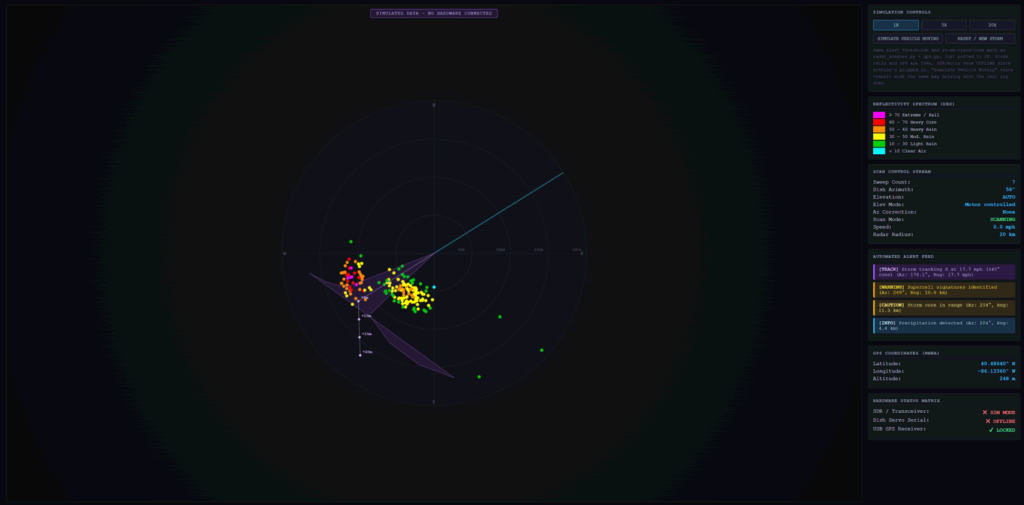
A demo of the weather radar display
Hardware: Salvaged RV Dish + SDR
The core antenna is a recovered Winegard Carryout Anser GM-5000 automatic satellite dome, originally designed for RVs and available for around $5. Its LNB radiates an 850 MHz IF with a 10.4 GHz local oscillator, and 10.4 GHz turns out to be an ideal wavelength for weather radar.
The front-end SDR hardware comes in two flavors:
- HackRF: half-duplex, using pulsed timing.
- PlutoSDR: full-duplex, using a continuous FMCW chirp.
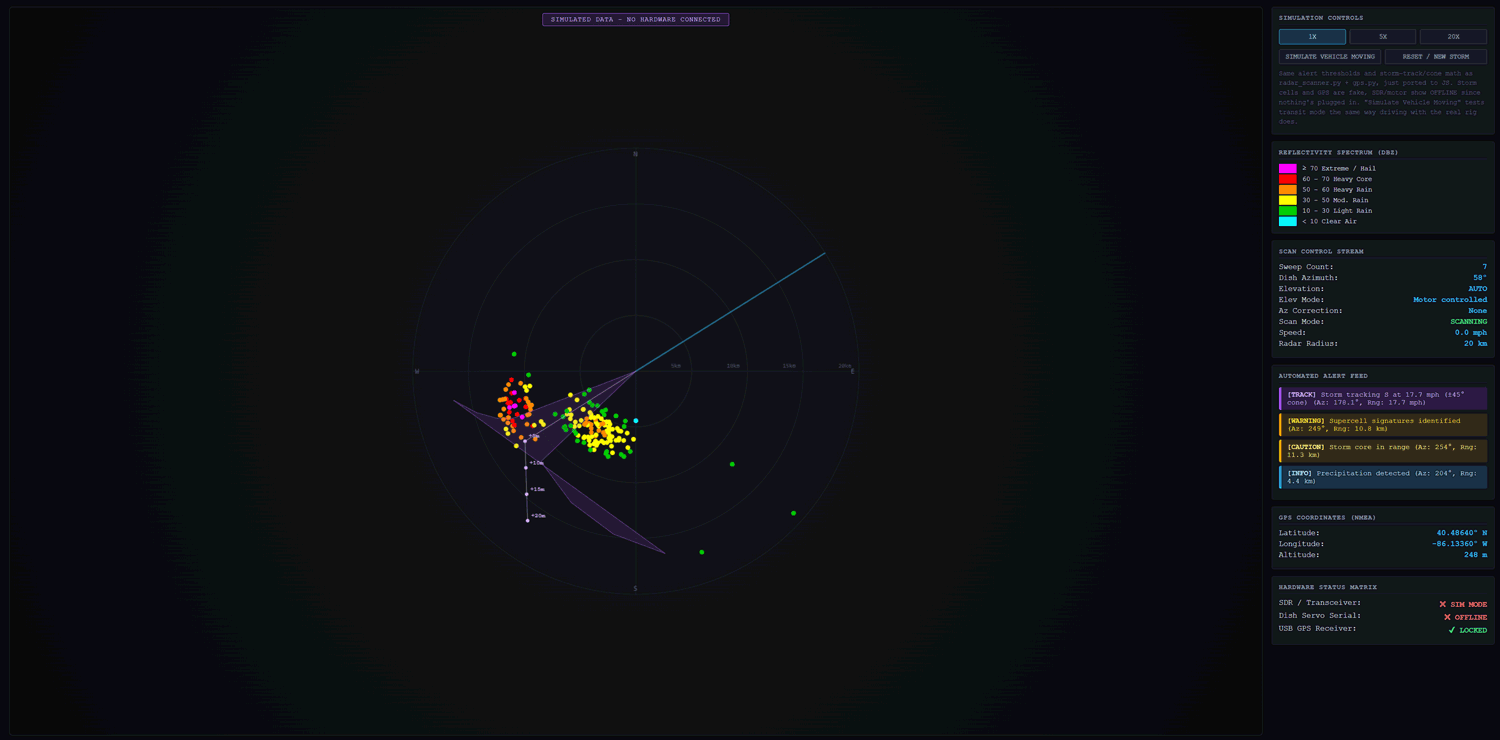
A demo of the weather radar display (full-resolution)
Software: Open-Source Python Processing
Koakno wrote open-source Python software that ingests the returns, processes them, and renders a live radar display with a color-scaled reflectivity map. The screenshot above was generated via the software's built-in simulation mode, so users can test the UI before attaching real hardware.
Licensing Notes
The post also addresses regulatory concerns head-on. FCC amateur radio rules contain provisions supporting automatically controlled beacons for propagation observation, as well as experimental activity in the 3 cm (10.0–10.5 GHz) amateur band. However, the author notes that he is not an attorney, and the activity may still sit in a grey area — readers should evaluate local regulations themselves.
Takeaway
This is a textbook example of combining "consumer-grade SDR + salvaged RF hardware + open-source signal processing" — and it showcases what SDR makes possible in the meteorological/radar space at hobbyist budgets. The project code is open-sourced on GitHub, ready to be replicated and extended.